
Social Visibility Is Now Measurable, Here's What It Means for Your Business
The bottom line: Search Console has always told website owners how they perform in Google Search. It has never told anyone how a video, a caption, or a post performs there, until now. Google has rolled out a new feature called platform properties, and for the first time, brands can verify an Instagram, TikTok, X, or YouTube account and get the same Search performance data (clicks, impressions, top posts, top queries) that Search Console has always reserved for websites. Unfortunately, LinkedIn is not part of the initial rollout. For firms in regulated industries, this is a visibility development, not a compliance one, but it is worth understanding now, before it shows up in your account.
What changed
Search Console has historically only reported on domains you own. Platform properties extends that reporting to four social platforms. Once you verify an account, you get three new reports: a Performance report (clicks, impressions, top-performing posts, and the queries driving them), an Insights report (traffic trends and discovery patterns), and an Achievements Report. Google is rolling this out gradually, so you might not see the option in its account for several more weeks.
Why this matters
This feature doesn't change your compliance obligations, social posts still fall under the same review, pre-approval, and recordkeeping requirements as any other public communication. What it changes is your ability to prove where that content is actually working. Firms have solid platform analytics (views, engagement, follower growth), but almost no visibility into whether content shows up in Google Search - a different, often better signal for whether educational content is reaching the people who need it.
A few places this is likely to matter most for our client base:
Video-heavy firms. If your team is producing market commentary, methodology explainers, or manager interviews on YouTube, this gives you the actual search terms bringing people to specific videos, not just after-the-fact watch-time data.
Founder- and PM-led content. If a portfolio manager's or founder's own account is doing real work bringing prospects to your firm, you'll finally have data on what people were searching for right before they found that content.
Firms treating owned and earned channels as separate reporting lines. This is the bigger shift. You'll be able to look at your website's Search performance and your video/social performance in the same tool, which makes it much easier to report on visibility as one connected system (rather than a website metric and a social metric that never talk to each other).
The obvious gap: LinkedIn isn't included
For a client base built on advisor relationships, institutional credibility, and founder thought leadership, this is the detail that matters most. LinkedIn is arguably the primary platform for this entire audience, and it's the one platform of the major four missing from this launch. LinkedIn content already has a harder time surfacing in Google Search than Instagram, TikTok, or YouTube content, and now it's also missing from the tool that would let you measure that gap directly.
There's no indication yet that Google plans to add it. For now, the practical response is the same one that's always applied to LinkedIn and Google Search: write posts that lead with the specific language, named problems, and real questions your audience is actually searching for, since you won't have Search Console data to tell you if it's working.
What to do now
Check Search Console periodically over the next several weeks for the option to add a platform property. The rollout is gradual, don't assume something's wrong if you don't see it yet.
Prioritize YouTube verification as soon as it's available if your firm produces video content of any kind.
Lead with keyword-relevant language in LinkedIn posts, particularly the first sentence, given both its function as the URL slug and LinkedIn's exclusion from this new reporting.
Treat this as one more argument for connected reporting - a single view of where your firm shows up, across your website, your video content, and your social presence, rather than separate areas for "SEO" and "social."
Visibility does not stop at your website's edge anymore, if it ever did. It lives in a YouTube explainer, a founder's LinkedIn post, a fact sheet that surfaces in a search someone ran before they ever heard of your brand. Firms that treat those as one connected system, measured and reported on together, are going to have a much easier time proving what is actually working than firms still running social and search as two separate lines.
Other social media updates you might have missed
Facebook. Meta added a Creator Activity section to the Professional Dashboard for Pages, giving page managers a clearer read on growth and posting consistency. Separately, Meta rolled out an "AI Mode" for Facebook search, which uses Meta AI to surface answers pulled from public posts across the platform, another sign that what you post publicly is increasingly treated as retrievable, citable content, not just a feed post.
YouTube. Google is building new Gemini-powered insight tools for creators, aimed at surfacing deeper trend data on what's resonating. More notably: YouTube creator content already appears in roughly a quarter of AI chatbot responses generally, and in high-intent categories (like financial services) that figure climbs to nearly one in two. If your firm produces video, it's already showing up in AI-generated answers more than most other content types.
LinkedIn. LinkedIn shared guidance on optimizing posts for AI visibility, including a detail worth building into your writing process: the first sentence of a LinkedIn post becomes its URL slug, so leading with the relevant keyword and topic, rather than a hook line, has a direct, mechanical effect on discoverability. LinkedIn also added an "In and Out of Network" breakdown to post analytics, showing what share of your reach is coming from outside your existing connections, a more honest read on whether content is actually extending your reach or just circulating among people who already follow you.
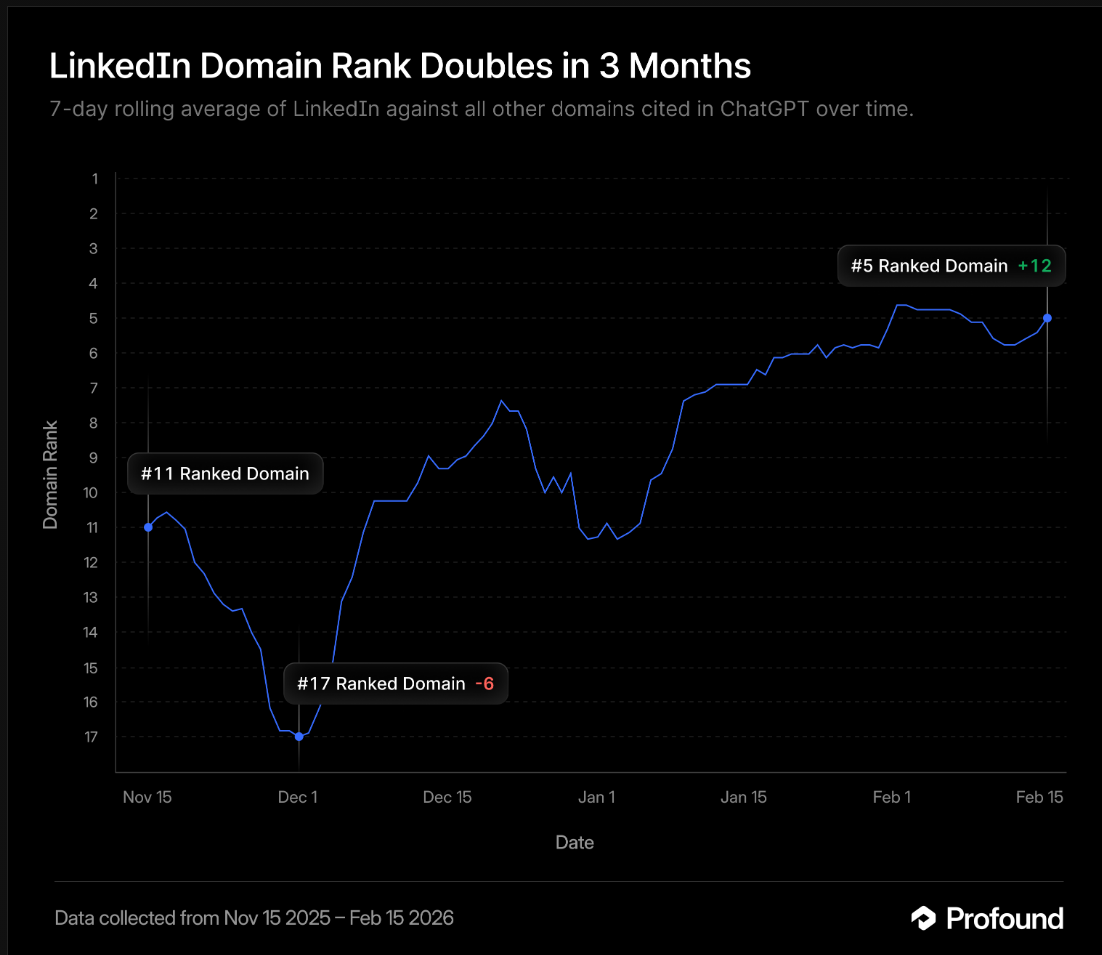
There's a bigger visibility shift happening around LinkedIn that this Search Console gap doesn't capture. According to research firm Profound's analysis of AI chatbot citations, LinkedIn's citation frequency has doubled since November, making it the most-cited domain for professional queries across ChatGPT, Gemini, and other major AI platforms. Separately, Semrush's analysis of over 300,000 prompts found LinkedIn trailing only Reddit as the most-cited source in AI-generated answers overall. In other words, while LinkedIn content still can't be measured in Google Search Console, it's increasingly the material AI tools are pulling from to answer the exact questions your prospects are asking. That makes structured, expert-driven LinkedIn content (clear headings, specific claims, individual authorship) less of a nice-to-have and more of a second visibility channel worth tracking, even without a native reporting tool to measure it yet.
If you are trying to figure out what your firm's visibility actually looks like across search, video, and social, or want a compliance-sound way to start measuring it, that is where we come in. Kane & Hook works with firms to build the messaging, materials, and reporting infrastructure that make visibility provable, not just assumed. If any of that sounds like what you need, we would love to talk. To learn more, email sarah@kaneandhook.com or connect with us on LinkedIn.