
The bottom line: A lead magnet is a free, genuinely useful resource, such as a guide, checklist, or white paper, that a prospect exchanges for their contact information. For service providers, where trust has to be earned long before a contract is signed, it is one of the most dependable ways to turn anonymous website traffic into opted-in leads. It is also one of the most compliance-friendly, because the prospect raises their hand first. It takes time and effort, but it is a proven system that works.
At FutureProof 2026, one question came up in meeting after meeting: what should a lead magnet actually look like for our audience? We explored the broader challenge in The Top of the Funnel Problem: How Advisors, Asset Managers, and Service Providers Can Close the Growth Gap in 2027. This piece takes the next step and walks through how a lead magnet works, from the first download to the follow-up that turns a name in your CRM into a client.
What a lead magnet actually is
A lead magnet is not a brochure. It is not a sales pitch with a download button attached. It is a piece of real expertise, written for a specific audience, that solves a specific problem. For a wealth management firm, that might be a retirement income checklist. For a law firm, a plain-language guide to a regulatory change. For a consultancy, a benchmarking report. The test is simple: would your ideal client be glad they downloaded it even if they never called you?
If you are not sure where to start, begin with your own first meetings. The questions prospects ask you in nearly every introductory conversation are a ready-made content list, a point we raised in our FutureProof recap. Each one is a lead magnet waiting to be written.
How the funnel works
The mechanics are straightforward. Your firm publishes a free PDF on its website, aimed squarely at your target audience. A visitor who wants it fills out a short form: name, company, email. Keep it short. Every extra field costs you conversions, and you can always learn more later.
That form submission does three things at once. It delivers the download, records the visitor's consent to receive email from your firm, and (in a perfect world where your website is connected to your CRM) it creates a contact in your CRM, tagged with the specific resource they downloaded. That tag matters. A prospect who downloaded your guide on succession planning is telling you something very different than one who downloaded your market outlook, and your follow-up should reflect it.
Now that download is a lead. The lead is flagged in the CRM and enrolled in a drip campaign: a short series of emails delivered over several weeks (or months), each one offering more thought leadership and high-value content tied to the topic that brought them in. Where it makes sense, a salesperson follows up with a personal email or a phone call. The goal is not to close on the first touch, it’s to stay useful until the prospect is ready to talk.
Where LinkedIn comes in
For firms built on advisor relationships and founder credibility, LinkedIn is where the funnel is most likely to start, and where it is most likely to be accelerated.
Use posts to point to the magnet. A post that offers a specific, useful resource, written in the language your audience actually searches for, earns more attention than a general brand update. As we covered recently, the first sentence of a LinkedIn post becomes its URL slug, so lead with the topic and keyword, not a hook line. LinkedIn also now shows how much of your reach comes from outside your network, which makes it easy to see whether a post is finding new people or just circulating among existing followers.
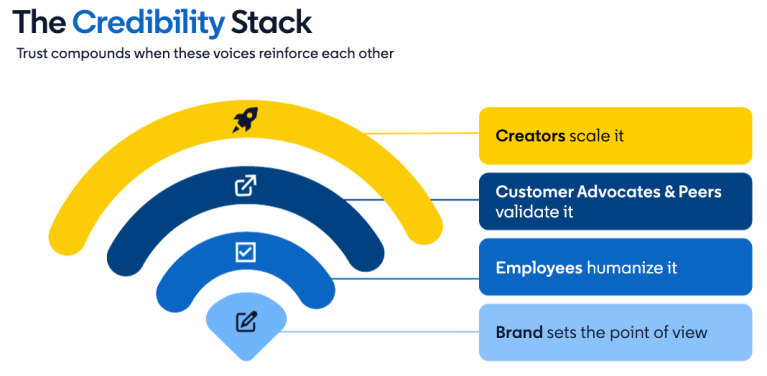
Put your people behind it. Who shares your lead magnet matters as much as what is in it. According to Meltwater’s 2026 analysis, as reported by LinkedIn, roughly three out of four LinkedIn citations in AI-generated answers came from individual member profiles, and only one in four from Company Pages. Size was not the deciding factor either: about a third came from members with fewer than 10,000 followers who simply post consistently. A guide promoted only from your Company Page is working with the smaller share. A guide shared by the portfolio manager, founder, or advisor whose expertise it reflects carries more credibility and reaches further. LinkedIn also notes that AI tools look for corroboration, so one post rarely earns a citation, but a body of content that returns to the same theme from several credible voices is more likely to. That is a good reason to support each lead magnet with a short run of posts rather than a single announcement.
For regulated firms, this means settling one question up front: posts from individual team members are firm communications, too. They fall under the same review, pre-approval, and recordkeeping requirements as anything published from the company page.
Source: Linkedin
Consider LinkedIn's native lead forms. On one of its paid business page tiers, LinkedIn offers a Lead Gen Form. These forms pre-fill a viewer's profile information, which reduces the friction from interest to opt-in. Pair them with a clear consent statement and you can pass those leads into the same CRM and the same nurture sequence as your website downloads.
Retarget with video. Website visitors and CRM contacts can be built into audiences for LinkedIn ads, which means a prospect who downloaded your guide can later see a short video from your portfolio manager or founder on the same topic. Video builds familiarity faster than text, and familiarity is what moves a lead from a name in a database toward a conversation.
Let sales follow the signal. Once someone has opted in and engaged with your content, a personal LinkedIn message from a member of your team is a natural next step. It is not a cold pitch. It is a follow-up to something they asked for. The order matters: the download comes first, and the outreach follows.
Keep the front door open for GEO
There is one timely wrinkle. Content behind a form cannot be read by search engines or by the AI tools (GEO) that increasingly answer your prospects' questions. The fix is to publish a public landing page for each resource, with a clear summary, key takeaways, and the author's credentials, and gate only the full download. The public page is what gets found. The form is what captures the lead.
Compliance is the point, not the obstacle
This is where lead magnets earn their reputation among regulated firms. Because the lead opts in through your website, you have a documented record of consent. To keep it that way:
Use an unchecked opt-in box and a plain-language statement of what they will receive.
Link to your privacy policy at the point of capture.
Include a working unsubscribe in every email.
Never purchase lists or add people to your drip campaigns who did not ask to be there.
Remember that the lead magnet itself, every email in the sequence, and every ad you run are communications to the public. They fall under the same review, pre-approval, and recordkeeping requirements as anything else you publish. Build that review into the process up front, and approve the full sequence once, rather than one email at a time.
Measure what matters
Track three things: how many website visitors become leads, how many leads open and engage with your sequence, and how many turn into real conversations. Those numbers will tell you which resource is working, which subject line is not, and where your funnel is leaking.
A lead magnet is not a one-time project. It is a system: a resource, a form, a CRM, a sequence, and a team that follows up. Firms that build all five will have a steady, compliant source of pipeline. Firms that build only the PDF will have a PDF.
If you are trying to figure out what your firm's top of funnel looks like, or want a compliance-friendly way to turn website visitors into qualified leads, that is where we come in. Kane & Hook works with firms to build the messaging, materials, and nurture sequences that make lead generation consistent, measurable, and compliant. If any of that sounds like what you need, we would love to talk. To learn more, email sarah@kaneandhook.com or connect with us on LinkedIn.